 Image 1 of 1
Insight is where change starts, not where it ends.
Your client leaves session understanding exactly why they shut down, rescue, or escalate, and still does the same thing on Tuesday night. Under stress, people fall back on what they can already picture themselves doing. If they can’t envision themselves saying or using a new skill, they go back to their baseline.
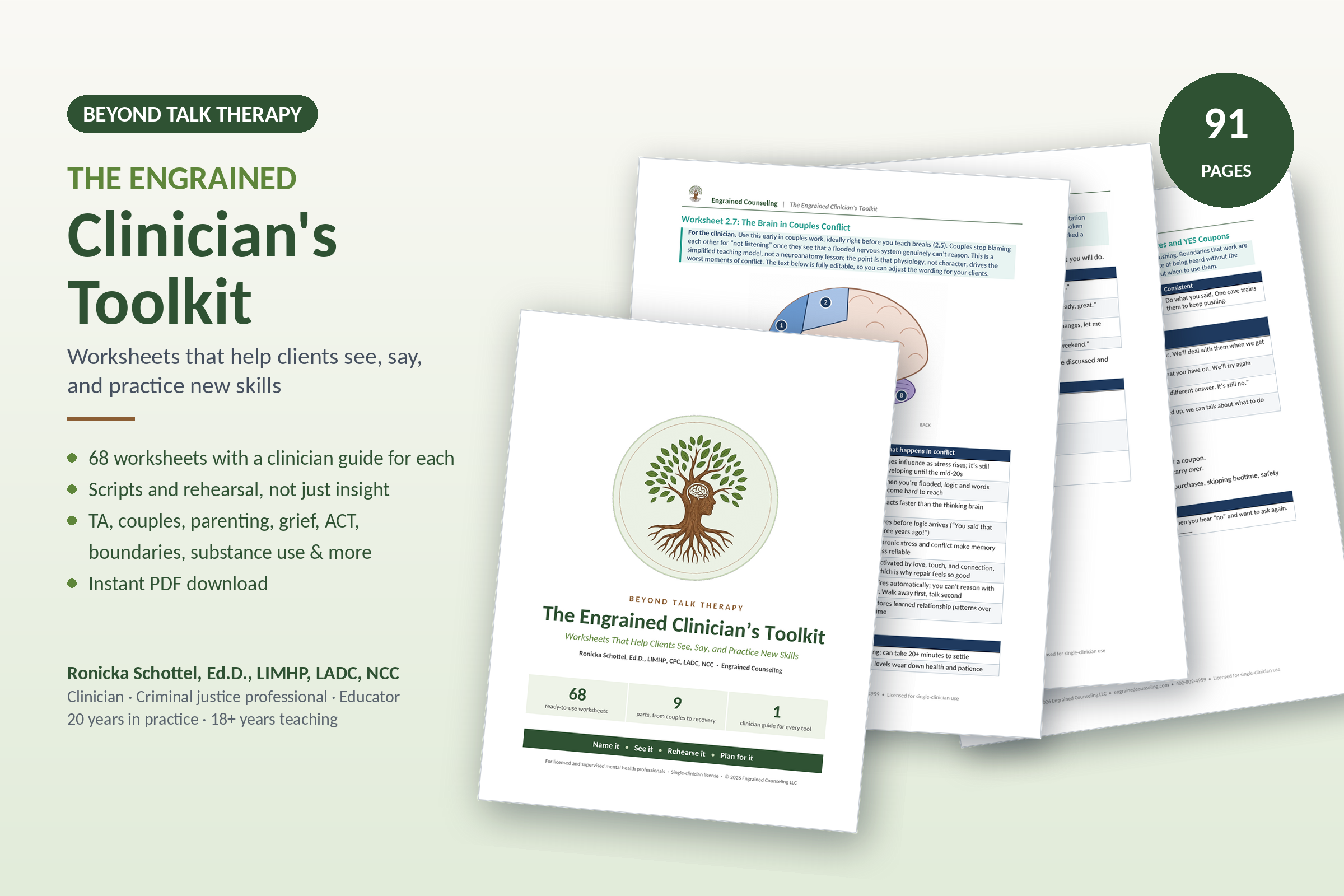
The Engrained Clinician’s Toolkit is built to close that gap. Every worksheet moves clients beyond talking about a pattern to:
Name it in their own words
See what the healthier alternative looks and sounds like
Rehearse it on paper before trying it in real life
Plan for the exact moment the old pattern shows up
What’s inside
68 ready-to-use worksheets in nine parts, each opening with a “For the clinician” guide explaining what it’s for, when to use it, and what to watch for, so you can use it in session without extra prep.
Transactional Analysis: ego states, scripts, and rewriting from the Adult
Couples communication (Gottman-informed): soft startups, the Rolodex pattern, locking patterns, repairs, flooding, and breaks
Individual pattern work: self-sabotage, “whose voice is in the room,” values vs. avoidance, worthiness, and schemas
Codependency, boundaries, and regulation: boundaries that hold, consistency, and the shutdown response
ACT defusion and noticing: including why affirmations often don’t work
Parenting from the Adult: PAUSE, natural consequences, YES coupons, repair, and calm-down stories for kids
Feelings and the body: moving intellectualizing clients from thinking to feeling
Grief, loss, and betrayal: somatic grief, loop interruption, and betrayal trauma processing
Substance use education: the brain on alcohol, habit loops, recovery planning, and a medication conversation guide
Who it’s for
Licensed and supervised therapists, counselors, and social workers who work with individuals, couples, families, or substance use clients, especially clients who “know what to do” but can’t seem to do it.
About the author
Ronicka Schottel, Ed.D., LIMHP, CPC, LADC, NCC, brings roughly 20 years across clinical counseling and criminal justice, including probation, domestic violence shelter management, home-based family services, and forensic evaluation. She has taught criminal justice and counseling in higher education for more than 18 years and has completed Gottman Method Level I and II training and Gottman Couples in Recovery.
Details
91-page PDF, instant download
Printable, with write-in space on every worksheet
Single-clinician license: print and use with your own clients